If you or someone you love is suffering from back pain, you understand the search for an answer to the pain. The search for relief can go on year after year. We believe Regenerative Orthopedics is one of the best treatments for low back pain.
At our clinic, we see back pain sufferers who have already tried many different treatment options like supplements, painkillers, anti-inflammatories, antidepressants, massage, and possibly even surgery. And sure, they may help the sufferer achieve some relief, but often, the help is only temporary.
Why doesn’t the relief last? Unfortunately, these common treatments for back pain do not address the real problem. Sure, they may address pain or inflammation, but pain and inflammation are symptoms of the underlying problem. What is the root cause of the pain and inflammation?
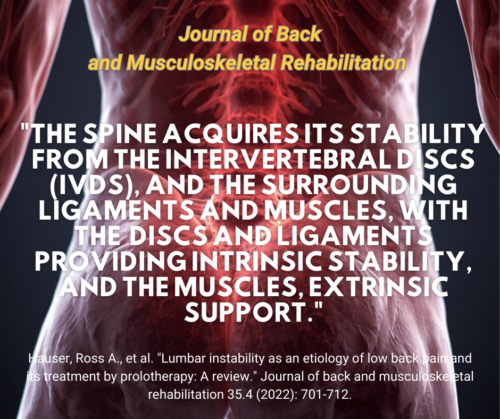
Very often, the underlying problem causing back pain is instability. Here’s what researchers say: “The spine acquires its stability from the intervertebral discs (IVDs), and the surrounding ligaments and muscles, with the discs and ligaments providing intrinsic stability, and the muscles, extrinsic support.”(1)
Instability in the back occurs when the ligaments connecting bones become injured. Once ligaments are injured, they become more lax. With this laxness comes abnormal joint motion.
The body also responds to joint instability by causing joint swelling, muscle tightening, or bone spurs, thereby temporarily stabilizing the joints. With this said, the body’s overall response to worsening ligament laxity and instability in the lower spine is to initiate degenerative changes as a protective measure.
You’ve probably noticed that back pain comes and goes for many people. Back pain may be worse on some days and better on others. And when back pain is chronic, it continually comes back. Why does the pain always come back? If the underlying instability problem is not addressed, then the pain medications and anti-inflammatories only touch the symptoms of pain and inflammation. They do not repair the instability and abnormal motion in the vertebrae.
Like we said earlier, treatments like pain medications do not address the root cause. They may touch on some of the symptoms, but they don’t address the cause. Care for chronic low back pain is often very frustrating to clinicians and patients. It’s frustrating because the commonly used treatments come up short. The Journal of Orthopaedic Surgery and Research says this, “The benefits are just not there to justify the routine prolonged use of any given drug in nonspecific chronic low back pain: this is a major challenge, and it is often hard to accept for clinicians and patients . . . ”(2)
There is also a subset of patients who have been prescribed narcotic pain relievers. Do these help long-term? The Journal of Osteopathic Medicine says, “Long-term opioid use (more than 12 months) patients had a worse disability, physical function, fatigue, and other pain-related problems, including the earlier onset of sleep disturbance.”(3)
As you can see, opioids do not help long-term, but rather increase disability.
Chiropractic manipulations are effective treatment modalities and are particularly useful for low back pain. As both a chiropractor and an MD, Dr. Fields will always recommend that a patient first seek help from a chiropractor for back pain. However, if the back pain persists and is not resolved after the recommended treatments, a ligament injury may be the cause. In cases of ligament injury, Regenerative Orthopedics should be sought, as it can effectively repair the injury.
Regenerative Orthopedic treatments repair the underlying damage to the ligaments and any involved tendons. These injured soft tissues naturally have a poor blood supply. But Regenerative Orthopedics increases blood flow to the ligaments. This increased blood supply helps the body to heal and repair. The result? The back is strengthening, the abnormal joint motion is stabilized, and the back pain sufferer experiences decreased pain and increased function!
Even if you have disc problems, the underlying issue is likely instability. Injured ligaments allow abnormal motion of the vertebrae and worsen disc problems. Damage to the spinal ligaments is at the core of the problem.
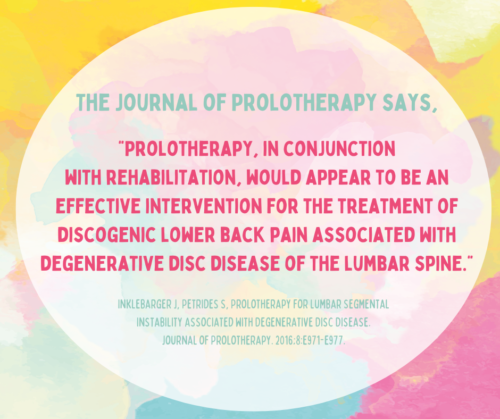
In degenerative disc disease, the disc height increases, and the lax ligaments lose tension. The vertebrae move even more, and the lack of stabilization increases pain in the discs and other spinal joint structures.
In many instances, the common underlying low back pain complaints, including arthritis and loss of spinal curve, are largely due to ligament injury. Instability in the spine is at the root of most chronic spinal pain.
Muscles are one of the stabilizing structures of the spine. If the back injury is muscular, standard treatments will address the pain. The intervertebral discs and surrounding ligaments also hold together and stabilize the spine.
When these standard treatments do not solve the problem of low back pain, underlying ligament damage and spinal instability need to be addressed. And the best treatment for back pain due to ligament damage is Regenerative Orthopedics.
Over time, after a traumatic injury, the ligaments will start to elongate and become loose and lax. Physically demanding activities or even sedentary postures can lead to this gradual loosening over time. Muscle spasms will develop because of these elongated ligaments. Swelling may occur, and eventually, arthritis will develop as the body attempts to stabilize the area by creating bone spurs.
Regenerative Orthopedics strengthens the spine’s ligaments and prevents further degeneration. It gets to the underlying issue causing low back pain. Prolotherapy is a type of Regenerative Orthopedics. Researchers in the Journal of Prolotherapy say, “In comparison to other soft tissues, ligaments have less vascularity. Once injured or degenerated, this lack of blood supply may delay healing. Prolotherapy may offer the stimulus for ligament regeneration.”(4)
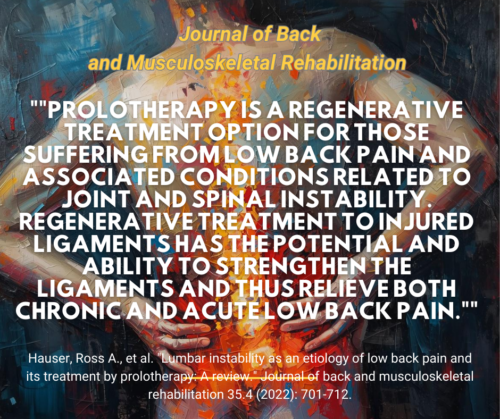
“Prolotherapy is a regenerative treatment option for those suffering from low back pain and associated conditions related to joint and spinal instability. Regenerative treatment to injured ligaments has the potential and ability to strengthen the ligaments and thus relieve both chronic and acute low back pain.” (1)
PRP Is an Effective Treatment for Low Back Pain
The Journal of Back and Musculoskeletal Rehabilitation concluded, “Prolotherapy can be regarded as a safe way of providing a meaningful improvement in pain and musculoskeletal function compared to the initial status. …5% dextrose is a simpler and painless solution for Prolotherapy and also has a high success.”(5)
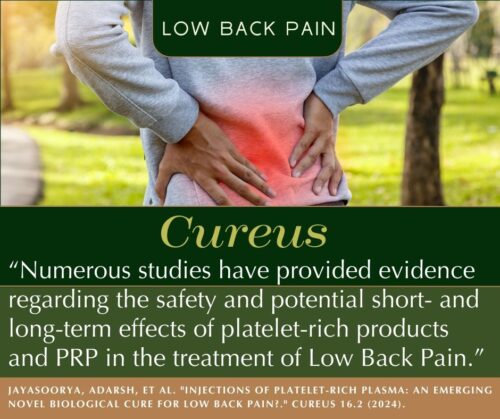
Also, a 2024 study in the medical journal Cureus found that PRP was effective for low back pain. They say, “Compared to steroids, autologous PRP is a better therapeutic option due to its longer-lasting effectiveness, according to the research. Numerous studies have provided evidence regarding the safety and potential short- and long-term effects of platelet-rich products and PRP in the treatment of low back pain.” (6)
A 2025 case study said, “The chronic back pain patient responded very well to Prolotherapy injections plus PRP. Six months later, a durable reduction in pain and improvement in mobility and activity were noted.”(7)
Remember, when back pain is an issue, the muscles may be in spasm because they are overcompensating for the injured ligaments as they try to stabilize the spine. Chiropractic adjustments will realign the spine, and Regenerative Orthopedics will effectively repair the ligaments, addressing the root of the back pain. Additionally, in cases of degenerative disc disease, Prolotherapy tightens the ligamentous structures and limits the abnormal vertebral motion, reducing the incidence of discogenic low back pain by improving stability.
(1) Hauser, Ross A., et al. “Lumbar instability as an etiology of low back pain and its treatment by prolotherapy: A review.” Journal of back and musculoskeletal rehabilitation 35.4 (2022): 701-712.
(2)Migliorini F, Maffulli N. Choosing the appropriate pharmacotherapy for nonspecific chronic low back pain. Journal of Orthopaedic Surgery and Research. 2022 Dec;17(1):1-3.
(3)Schultz MJ, Licciardone JC. The effect of long-term opioid use on back-specific disability and health-related quality of life in patients with chronic low back pain. Journal of Osteopathic Medicine. 2022 Aug 11.
(4)Inklebarger J, Petrides S, Prolotherapy for Lumbar Segmental Instability Associated with Degenerative Disc Disease. Journal of Prolotherapy. 2016;8:e971-e977.
(5)Solmaz I, Orscelik A, Koroglu O. Modified prolotherapy by 5% dextrose: Two years experiences of a traditional and complementary medicine practice center in Turkey. Journal of Back and Musculoskeletal Rehabilitation. 2021(Preprint):1-8.
(6) Jayasoorya, Adarsh, et al. “Injections of Platelet-Rich Plasma: An Emerging Novel Biological Cure for Low Back Pain?.” Cureus 16.2 (2024).
(7) Hobson, Jessica, and Andrew Vargo. “Step-Up Regenerative Injection Therapy for Severe Chronic Low Back Pain Utilizing Epidural Dextrose Solution (Prolotherapy), Local Platelet-Rich Plasma, and Epidural Platelet-Rich Plasma: A Case Report and Suggested Protocol.” CAND Journal 32.1 (2025): 27-32.