The ACL is a ligament in the middle of the knee designed to stabilize the tibia (shin bone) on the femur (thigh bone). It lies anterior to another ligament, the PCL. Together, the ACL and PCL prevent the shin bone from sliding too far forward and stabilize it below the thigh bone. The ACL’s job is to prevent these bones from moving excessively. When it is injured or absent, it places stress on the other ligaments to prevent excessive motion. ACL knee treatment is often necessary when the ligament is injured, but surgery is not always required. We will discuss this more throughout this article.
The PCL is the knee’s primary stabilizer and is almost twice as strong as the ACL. Ligaments can be torn during sports or trauma. When these ligaments are injured, the knee becomes unstable. Knee instability is commonly the source of the problem surrounding ACL tears. The Journal of Surgery explains, “ACL tear in concomitant chronic ACL and posterior cruciate ligament (PCL) deficient knees may produce knee laxity…” (1)
ACL reconstruction surgery can have excellent results. However, those who come into our office are seeking non-surgical alternatives, possibly because ACL surgery did not work great for them, they are exploring options to return to sports, or they’d like to avoid the advancement of osteoarthritis. Others just want to avoid surgery!
The Arthroscopy Journal says, “ACL reconstruction is the mainstay of treatment, although the procedure is not without complications such as recurrent graft rupture, donor site morbidity, poor proprioception, development of post traumatic arthritis and difficulty returning to preinjury level of activity.” (2)
No, surgery replaces natural bands of ligaments. As noted earlier, injury or removal of ligaments boosts knee instability. The new ACL is weaker and less functional than the original (2). Surgery will change the biomechanics of the knee. Knee position is altered, which can lead to a higher rate of ACL tear in the opposite (non-surgical) knee after surgery (3).
The best ACL treatment should provide stability and treat the entire knee by ensuring that any other ligament or meniscal injuries are addressed. If all structures are not repaired, knee healing will be impeded. Surgery may not address these other injuries. For this reason, many patients are now searching for a non-surgical treatment for ACL tears. In August 2023, German sports trauma specialists wrote: “The aim of treatment of a ruptured anterior cruciate ligament (ACL) is the return of the patient to an acceptable level of activity without giving way phenomena as well as adequate treatment of prognostically relevant concomitant lesions.” (4) All concomitant injuries, such as PCL, meniscal, or medial collateral ligaments, need to be treated to repair the knee optimally.
Regenerative Orthopedics are non-surgical alternatives to knee surgery, including stem cell therapy, Platelet-Rich Plasma, and Prolotherapy. These treatments can restore strength and function to injured ACLs in many patients. They are designed to strengthen the entire knee capsule. When concomitant injuries are present, regenerative treatments are effective at repair because they can treat all ligaments and menisci. This comprehensive treatment will facilitate ACL healing. The entire knee is strengthened, thereby helping to prevent knee instability and the development of degenerative arthritis.
The goal of these treatments is to treat a partial tear or an overstretched ACL. These regenerative medicine injections cannot regrow an ACL from nothing. Therefore, if there is a complete disintegration of the ligament, it cannot be regrown.
Prolotherapy Is Effective for Ligament and Tendon Repair
Regenerative Orthopedics are popular treatments for chronic pain. They promote the growth of normal cells and tissues. Prolotherapy targets the structural and regenerative basis of joint pain rather than symptom control, as it restores connective tissue integrity, enhances ligamentous stability, and activates wound-healing pathways. Prolotherapy addresses key biomechanical and cellular contributors to persistent pain and functional impairment.
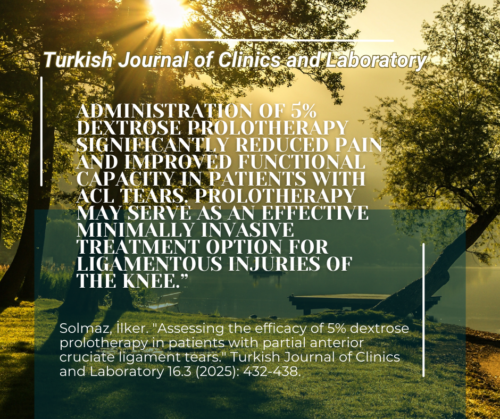
The Turkish Journal of Clinics and Laboratory reported that the “administration of 5% dextrose prolotherapy significantly reduced pain and improved functional capacity in patients with ACL tears. Prolotherapy may serve as an effective minimally invasive treatment option for ligamentous injuries of the knee.” (5)
Research also demonstrates that PRP and Stem Cell treatments improve healing and outcomes in ACL repair.
The Orthopedic Journal of Sports Medicine found that biologically augmented ACL-repair techniques (PRP and stem cells) improve healing and outcomes of both the native ACL (non-surgery) and the reconstructed graft tissue (surgery). (6)
In 2003, researchers in the journal Alternative Therapies in Health and Medicine reported that prolotherapy improved joint laxity, range of motion, and pain during walking. (7)
For older patients, the European Journal of Translational Myology writes: “In old patients with ACL rupture, surgery is not recommended due to the person’s low level of activity and knee osteoarthritis. Platelet-rich plasma (PRP) is a good treatment option in inflammatory cases in orthopedics.” (8)
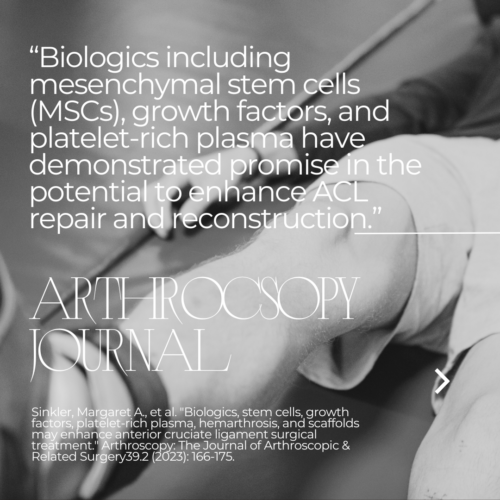
And the Arthroscopy Journal says, “Biologics including mesenchymal stem cells (MSCs), growth factors, and platelet-rich plasma have demonstrated promise in the potential to enhance ACL repair and reconstruction.” (2)
Stem Cell Therapy is often used in more advanced conditions. We use bone marrow stem cells in conjunction with other regenerative solutions. The good news is that during the time of healing, patients can exercise and start getting back into great shape.
Doctors wrote in the Archives of Orthopaedic and Trauma Surgery saying:
“The ACL has the potential to heal upon intensive non-surgical rehabilitation procedures. Understanding the mechanisms of this regeneration process and the cells involved may pave the way for novel, less invasive, and biology-based strategies for ACL repair.”(9)
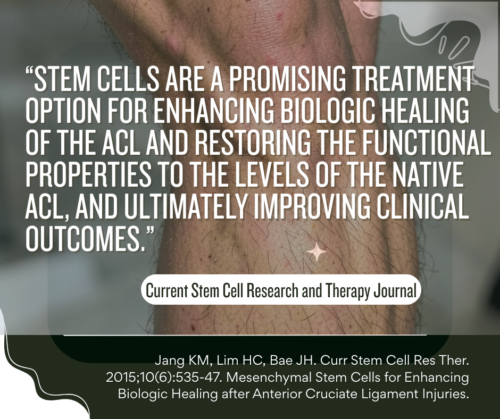
Since many patients continue to experience residual knee instability, knee pain, and progressive cartilage degeneration following ACL reconstruction, researchers in the journal Current Stem Cell Research and Therapy researched stem cell treatment for ACL repair. They found that stem cells are a promising treatment option for enhancing biologic healing of ACL grafts, restoring functional properties to levels comparable to those of the native ACL, and ultimately improving clinical outcomes.
Regenerative treatments utilize your own healing cells without surgery and are great surgical alternatives that research has shown to be effective. The goal is to promote healing of the damaged ligament and other involved structures so that the patient can retain their native ACL, with both bands intact, and all other original structures, preserving their biomechanics.
Regenerative Orthopedics is a game-changer. We’ve helped many professional, college, and weekend athletes recover from ACL tears and avoid surgery. Regenerative Orthopedics is a credible ACL surgery alternative for many who want to avoid the long downtime and dramatic changes in their natural biomechanics that surgical procedures can produce.
(1) Sazali S, Rusdi A, Siti HT. Association of ACL Laxity Tests with Arthroscopic Findings in Chronic ACL and PCL Deficient Knees. The Surgery Journal. 2018 Jan;4(1):e43.
(2) Sinkler, Margaret A., et al. “Biologics, stem cells, growth factors, platelet-rich plasma, hemarthrosis, and scaffolds may enhance anterior cruciate ligament surgical treatment.” Arthroscopy: The Journal of Arthroscopic & Related Surgery39.2 (2023): 166-175.
(3) Grassi A, Carulli C, Innocenti M, et al. New Trends in Anterior Cruciate Ligament Reconstruction: A Systematic Review of National Surveys of the Last 5 Years. Joints. 2018;6(3):177–187. Published 2018 Sep 27. doi: 10.1055/s-0038-1672157
(4) Magnussen RA, Meschbach NT, Kaeding CC, Wright RW, Spindler KP. ACL Graft and Contralateral ACL Tear Risk within Ten Years Following Reconstruction: A Systematic Review. JBJS Rev. 2015 Jan 20;3(1). pii: 01874474-201501000-00002. doi: 10.2106/JBJS.RVW.N.00052.
(5) Solmaz, İlker. “Assessing the efficacy of 5% dextrose prolotherapy in patients with partial anterior cruciate ligament tears.” Turkish Journal of Clinics and Laboratory 16.3 (2025): 432-438.
(6) Häner M, Petersen W. Treatment of acute injury of the anterior cruciate ligament: Always only reconstruction?. Unfallchirurgie (Heidelberg, Germany). 2023 Aug 19.
(7) Dallo I, Chahla J, Mitchell JJ, Pascual-Garrido C, Feagin JA, LaPrade RF. Biologic Approaches for the Treatment of Partial Tears of the Anterior Cruciate Ligament: A Current Concepts Review. Orthopaedic Journal of Sports Medicine. 2017 Jan 25;5(1):2325967116681724
(8) Reeves KD Hassanein K Long term effects of dextrose prolotherapy for anterior cruciate ligament laxity: A prospective and consecutive patient study. Alt Ther Hlth Med May-Jun 2003, 9(3): p58-62.
(9) Eslami S, Fattah S, Taher SA, Rezasoltani Z. Platelet-rich plasma therapy or arthroscopic surgery on repair of anterior cruciate ligament rupture. Eur J Transl Myol. 2022 Aug 1. doi: 10.4081/ejtm.2022.10538. Epub ahead of print. PMID: 35916761.
(10) Hirzinger C, Tauber M, Korntner S, Quirchmayr M, Bauer HC, Traweger A, Tempfer H. ACL injuries and stem cell therapy. Archives of Orthopaedic and Trauma Surgery. 2014 Nov 1;134(11):1573-8.
(11) Jang KM, Lim HC, Bae JH. Curr Stem Cell Res Ther. 2015;10(6):535-47. Mesenchymal Stem Cells for Enhancing Biologic Healing after Anterior Cruciate Ligament Injuries.