Alternative Knee Treatment
Patients facing knee surgery are often dealing with severe knee pain, limitations in movement, and interference with daily activities. Those trying to decide about knee surgery have probably already tried anti-inflammatories, cortisone injections, hyaluronic acid injections, PT, and massage. If those treatments failed to bring the results they had hoped for, surgery seems to be the only remaining answer. But is it? No, there is a non-surgical alternative to knee surgery…Regenerative Orthopedics!
One of the reasons Regenerative Orthopedics is so effective for knee pain is because it addresses the entire knee. It is also directed at the instability that is likely present due to soft tissue damage fro ligament, tendon, or meniscus damage. And instability in the knee is what commonly leads to arthritis.
So does that mean Regenerative Orthopedics can treat arthritis? Yes, the underlying instability that leads to arthritis and knee degeneration can be addressed with Regenerative Orthopedics.
Knee instability results from an old or new injury in the knee. The knee injury may have occurred during an old sports injury or a fall. Or it may be due to wear and tear over the years. These knee injuries affect the soft tissue of the knee, such as the ligaments, tendons, and/or the meniscus. Often, it’s not just one ligament or structure that is damaged. If the force during the original injury was significant enough to damage one ligament or one tendon, then other joint structures were likely affected. And all of these need to be treated.
Regenerative Orthopedics can stabilize the knee and halt the degenerative process caused by these injuries. These regenerative treatments can stop the cycle of degeneration, reduce pain, and improve function.
Osteoarthritis is the main reason people undergo surgery, such as a knee replacement. Arthritis occurs due to instability of the knee joint. Knee osteoarthritis is a progressive disease. It did not just happen overnight! Weak or injured ligaments cause the joint to move abnormally. That abnormal movement changes the forces on the knee joint, leading to increasing joint damage. Eventually, joint degeneration destroys the cartilage, leading to arthritis.
Regenerative Orthopedic treatments, such as Prolotherapy, PRP, and Stem Cells, have been shown to improve arthritis pain. The journal Orthopedic Reviews says, “Numerous clinical trials show significant improvement of osteoarthritic pain of the knee without any significant side effects reported following the use of prolotherapy…the results consistently show significant improvement in radiographic outcomes, pain scores, and quality of life with prolotherapy treatment.” (1)
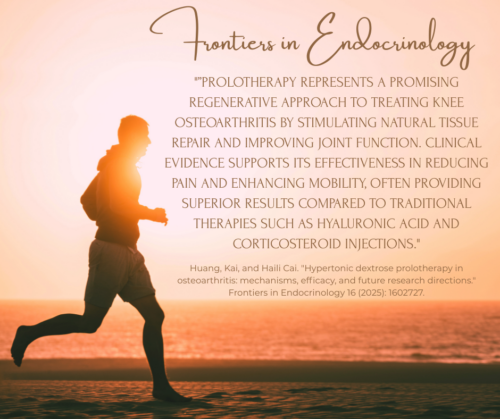
Researchers in Frontiers in Endocrinology say, “Prolotherapy represents a promising regenerative approach to treating knee osteoarthritis by stimulating natural tissue repair and improving joint function. Clinical evidence supports its effectiveness in reducing pain and enhancing mobility, often providing superior results compared to traditional therapies such as hyaluronic acid and corticosteroid injections.”(2)
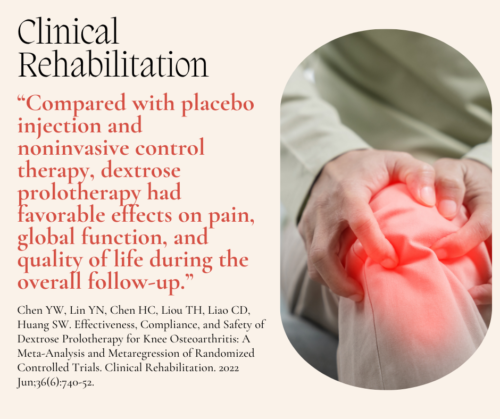
In 2022, the journal Clinical Rehabilitation examined the effectiveness of Prolotherapy in patients with knee osteoarthritis. The outcome? Prolotherapy showed favorable results, yielding greater reductions in pain scores than placebo and achieving comparable pain and functional outcomes compared with other invasive and non-invasive therapies. (3)
The journal Therapeutic Advances in Musculoskeletal Disease says, “Prolotherapy has been reported as a useful method in treating chronic musculoskeletal and joint diseases. It is proposed that Prolotherapy causes mild inflammation and cell stress in the weakened ligament or tendon area, releases cytokines and growth factors, and induces a new healing cascade in that area, which leads to the activation of fibroblasts, generation of collagen precursors, and strengthening of the connective tissue.” (4)
Another study in the Annals of Family Medicine reports these findings about Prolotherapy for knee osteoarthritis: “Intra-articular dextrose Prolotherapy injections reduced pain, improved function and quality of life in patients with knee osteoarthritis compared with blinded saline injections. The procedure is straightforward and safe; the adherence and satisfaction were high.” (5)
A February 2022 paper in the Osteoarthritis and Cartilage Open reviewed various knee arthritis treatments and provided evidence after comparing one set of treatments against another. What did they find? (6)
All of this research suggests that Regenerative Orthopedics is a viable treatment for knee osteoarthritis and an effective alternative to surgery!
We recommend treating the knee comprehensively with regenerative therapies targeting all involved structures. Remember that osteoarthritis does not occur suddenly; it is a degenerative process that develops over time. To achieve optimal results, all involved structures must be treated.
Regenerative Orthopedics is a safe and effective treatment option that addresses soft tissue damage and degeneration, resulting in the repair of the osteoarthritic knee. Knee osteoarthritis is one of the most common complaints that we see at OrthoRegen®.
Regenerative Orthopedics are excellent alternatives to surgery for knee conditions because they address the root cause…structural damage to the soft tissue of the knee that leads to degenerative changes in the knee. Stop the degenerative process with regenerative injection treatments such as Prolotherapy, PRP, and Stem Cells.