If you are experiencing knee pain, it’s understandable that you are looking for a treatment to resolve it. You are not alone! Knee pain is the most common problem we see. At one time or another, most of us will experience knee pain or dysfunction and require knee injury treatment. After all, we use our knees daily.
Because the knee is a weight-bearing joint, athletic and overweight people are more prone to knee pain and injuries. In addition to decreased range of motion and functional limitations, arthritis, tendonitis, patellar pain, and other knee conditions may develop. Whatever the cause, we need normal knee function to perform everyday tasks. Regenerative Orthopedics is an excellent and effective means to repair knee conditions and help us quickly return to daily activities.
Knee pain can develop suddenly (acute) or develop over time (chronic). Acute pain may result from a fall, slip, or other accident. Sports injuries are a common cause of acute knee injuries and pain.
Pain that develops chronically may result from an acute injury that did not heal properly. The prevalence of knee pain increases universally with age. Chronic conditions are the most common cause of knee pain and dysfunction. One of the most common causes of chronic pain is osteoarthritis. It is not uncommon for a ligament of the meniscus injury to progress to post-injury secondary knee osteoarthritis.
Osteoarthritis affects most of us as we age, steadily wearing away the smooth cartilage that caps the ends of our long bones. That cartilage is essential for the proper motion and function of the joint. The wearing down of the joint can be accelerated by overuse in sports or physically demanding jobs, by walking, by excessive sitting (which increases pressure within the knee), or by daily wear and tear. Referred pain, which occurs when a ligament injury or weakness in one part of the body causes pain in another part, may also be involved.
Knee pain often resolves on its own. Heat, ice, massage, PT, acupuncture, chiropractic, laser, and other treatments may help to resolve the pain.
Many people resort to anti-inflammatory medications and/or cortisone injections for their knee symptoms. Anti-inflammatory medications include ibuprofen, celecoxib (Celebrex), and Naproxen. Sure, these drugs sometimes relieve pain. Unfortunately, though, they are destructive rather than reparative. They can result in long-term loss of function and increased pain, as they inhibit the healing process and accelerate cartilage degeneration. Plus, when these drugs fail to achieve the sought-after results, other long-term medications or surgery will eventually be suggested. While these drugs may provide temporary relief, they do nothing to correct the underlying condition causing the pain. They do more damage than good.
Weaken ligaments and tendons
Inhibit ligament and tendon repair
Destroy cartilage
Raise blood pressure
Increase bleeding time
Irritate the gastrointestinal tract (stomach)
Cortisone, a steroid and one of the most potent anti-inflammatory medications, has even more significant risks than NSAIDs. Recommendations state that no more than three cortisone injections should be taken in a lifetime. Many professional athletes have received 40, 50, or more injections, which can result in a worn-out joint. Again, there may be relief, but the trade-off is not worthwhile.
Choose a reparative and regenerative treatment option, such as Regenerative Orthopedics, instead. Regenerate the knee instead of degenerating it! Stem Cell Therapy, PRP, and Prolotherapy are excellent non-surgical treatment solutions. Plus, they can get you back to doing what you love without needing extended time off.
There is a high likelihood that the knee pain sufferer will be referred to a surgeon. In surgery, some part of the knee structure will be removed, most likely the menisci or the ACL. When the entire or partial structures are removed, the knee is subjected to greater stress on the articular cartilage, predisposing it to an accelerated onset of osteoarthritis.
The current trend toward increasing surgical knee replacement warrants consideration of more conservative treatments to repair the knee. Surgical intervention is prudent and necessary for traumatic knee injuries, such as fractures and complete ruptures of major ligaments. However, non-surgical treatments are available for other acute and chronic knee joint conditions.
While osteoarthritis is a primary indication for arthroscopy of the knee, the American Academy of Orthopedic Surgeons Board of Directors recommended against the use of arthroscopy for osteoarthritis without mechanical pathology, citing an absence of significant benefit. (1) Another study compared arthroscopic debridement and arthroscopic lavage to a placebo and found no significant benefit from the arthroscopic procedures. Moreover, the authors found a significantly worse objective function during follow-up in the debridement group. (2)
Often, knee problems result from weakened or damaged ligaments. Ligaments supply reinforcement and stability to the knee. When damaged, the knee cannot move through its normal range of motion. The stability of the knee joint relies on many elements, including an interplay between the ligaments, muscles, meniscus, and bone, for proper joint function. When the ligaments are damaged, the injury may tear the menisci or wear away the cartilage and/or bone. However, surgery on these individual structures only addresses the effects, not the cause. Even after surgery, many patients continue to have the same pain or worse. The bottom line is that if you remove the structure, you change the function.
Since ligament or tendon damage is at the root of the problem, these structures must be repaired. Complete tears cannot be fixed without surgery. However, partial tears are very treatable without surgery. The patient’s best option is always to try to get these damaged areas to repair themselves. Even full-thickness tears may be fixable without surgery. Full thickness does not mean a complete tear.
Other times, the diagnosis is a torn meniscus. The meniscus does not usually tear on its own; there is usually a weakened or damaged ligament that puts increased pressure on the meniscus, causing it to tear. Removing the meniscus does not treat the cause of the problem.
Regenerative Orthopedics can successfully resolve the injury without the need for surgery. There are three types of Prolotherapy, or Regenerative Orthopedics, which work by stimulating the body’s healing system, making the process natural. By injecting various solutions, the body is triggered to repair itself. Regenerative Orthopedics is the safest and most effective treatment option for repairing ligament, tendon, and cartilage damage.
A recent medical journal says, “experimental, clinical, and mechanistic evidence supports prolotherapy as a biologically rational intervention that targets the structural and regenerative basis of chronic musculoskeletal pain rather than transient symptom control. By restoring connective tissue integrity, enhancing ligamentous stability, and activating endogenous wound- healing pathways, prolotherapy addresses key biomechanical and cellular contributors to persistent pain and functional impairment.” (3)
It is not surgery. Additionally, there are no surgical complications, such as poor wound healing, infections, or device failure.
There is no downtime. You might have to take it easy for a few days, but there is no period of immobilization. You can continue your normal activities and gradually return to exercise and full function within a week or two, as pain permits.
It is a natural way. It allows your own body to heal itself.
When fixed, it is permanent. You are better off than before you had Prolotherapy.
It is very safe. There are minimal, if any, side effects.
No scar tissue is formed. This might not be the case in surgical procedures.
The ligaments and tendons strengthened after Regenerative Orthopedics appear much the same as normal tissues, except they are thicker, stronger, and more vibrant. Regenerative Orthopedics is the safest and most effective natural medicine treatment for repairing tendon, ligament, and cartilage damage.
Does research show that Prolotherapy is effective for knee injuries? Data from numerous studies demonstrate the effectiveness of Prolotherapy for a range of musculoskeletal conditions. (4) Prolotherapy can stimulate soft tissue healing of the ligaments, tendons, and menisci, restoring the knee biomechanics and preventing the downward arthritic progression and pathophysiology of bony growth. (5) One study compared dextrose Prolotherapy to saline injection and exercise, and those who received Prolotherapy had a much more significant improvement. (6) The Annual Research & Review in Biology journal concluded that “Dextrose Prolotherapy is an effective treatment for patients with muscle, tendon, or ligament tears.” (7)
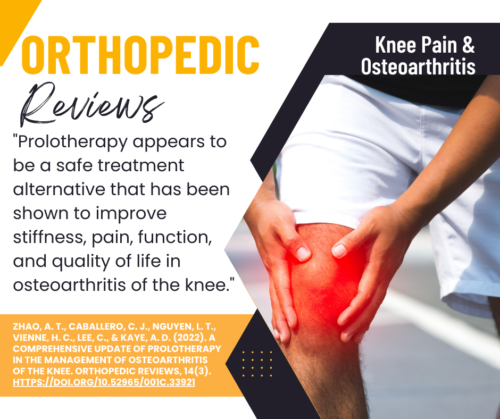
As far as osteoarthritis, the journal “Orthopedic Reviews” showed that “Prolotherapy appears to be a safe treatment alternative that has been shown to improve stiffness, pain, function, and quality of life in osteoarthritis of the knee.” (8) Several other studies have shown the effectiveness of Prolotherapy in treating osteoarthritic knees. In two separate studies using dextrose Prolotherapy to treat symptomatic knee osteoarthritis, Rabago et al. demonstrated that Prolotherapy was a safe treatment, resulting in significant and sustained improvements in pain, function, and stiffness scores. (9,10)
Many of my patients have had surgery but still experience pain. Regenerative Orthopedics can still help even for those who have already had surgery. For those who have not undergone surgery, please consider the alternative. Give us a call at 310-453-1234.
(1) American Academy of Orthopedic Surgeons Board of Directors. Treatment of osteoarthritis of the knee. Evidence-based guideline, 2nd edition; May 18, 2013.
(2) Moseley JB, O’Malley K, Petersen NJ, et al. A controlled trial of arthroscopic surgery for osteoarthritis of the knee. N Engl J Med 2002; 347(2):81-88.
(3) Solmaz, Ilker, and Mehmet Agilli. “PROLOTHERAPY IN CHRONIC MUSCULOSKELETAL PAIN: STRUCTURAL AND REGENERATIVE BIOMODULATION.” Anti-Aging Eastern Europe 4.4 (2025): 250-258.
(4) Rabago D. Prolotherapy for Chronic Musculoskeletal Pain. Complementary and Alternative Therapies and the Aging Population. 2011. Elsevier, London.
(5) Hauser R. Prolotherapy: An Alternative to Knee Surgery. Beulah Land Press. Oak Park, IL. 2004. p 62.
(6) Bae, Geonhyeong, et al. “Prolotherapy for the patients with chronic musculoskeletal pain: systematic review and meta-analysis.” Anesthesia and Pain Medicine 16.1 (2021): 81-95.
(7) Rhatomy, Sholahuddin, Evlin Margaretha, and Rizki Rahmadian. “Dextrose prolotherapy for muscle, tendon and ligament injury or pathology: a systematic review.” Annual Research & Review in Biology (2020): 43-62.
(8) Zhao, A. T., Caballero, C. J., Nguyen, L. T., Vienne, H. C., Lee, C., & Kaye, A. D. (2022). A Comprehensive Update of Prolotherapy in the Management of Osteoarthritis of the Knee. Orthopedic Reviews, 14(3). https://doi.org/10.52965/001c.33921
(9) Rabago D, Zgierska A, Fortney L, et al: Hypertonic dextrose injections (prolotherapy) for knee osteoarthritis: results of a single-arm uncontrolled study with1-year follow-up. J Altern Complement Med 2012; 18(4):408-414.
(10) Rabago D, Patterson JJ, Mundt M, et al: Dextrose prolotherapy for knee osteoarthritis: a randomized controlled trial. Ann Fam Med 2013; 11(3):229-237.