
Runner’s Knee Pain
Runner’s Knee is a painful knee condition that commonly affects runners. Another name for Runner’s Knee is also called Patellofemoral Pain Syndrome (PFPS). The condition is characterized by anterior knee pain. Runner’s Knee pain is commonly felt behind and around the kneecap (patella).
Runner’s Knee can affect one or both knees and is a knee complaint among athletes and non-athletes alike. And it particularly affects adolescents and young adults. Also, the condition is quite common in younger recreational runners, with females suffering more frequently than males.
Several forces act on the patella to provide stability and keep it tracking properly, as it articulates with the patellofemoral groove in the femur. The patella not only moves up and down but also tilts and rotates. And that movement allows for various points of contact between the patella and femur.
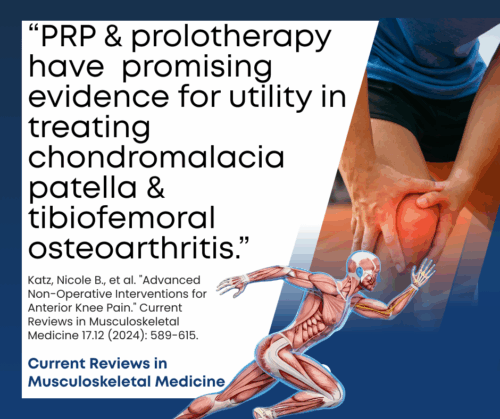
Repetitive contact at these locations, combined with the abnormal articulation of the patella, is thought to be the cause of the pain behind and around the patella in patellofemoral pain syndrome. Patellofemoral Pain Syndrome should be distinguished from chondromalacia, which is actual fraying and damage to the underlying patellar cartilage. Chondromalacia patella can be a cause of patellofemoral pain syndrome. Regenerative Orthopedics are effective at treating all of these conditions. Both PRP and Prolotherapy are promising non-surgical treatments for chondromalacia patella and other knee conditions. (1)
There are many theories to explain the pathophysiology of Runner’s Knee. They include muscular, overuse, and biomechanical theories. The cause of pain and dysfunction of Runner’s Knee may result from abnormal forces. Forces such as tight or weak quadriceps, along with subluxation or dislocation of the patellofemoral joint. Runner’s Knee may be due to prolonged repetitive activities such as running or jumping, which put excessive shearing forces on the patellofemoral joint.
Anatomic factors that predispose towards patellofemoral pain or instability include excessive rotation of the hip or shin bone, knock knees, hyperextended knees, and/or poor foot alignment. Ligamentous, meniscal, and soft tissue damage can also cause patellofemoral pain syndrome. Other causes of patellofemoral pain include fractures, knee arthritis, and bony tumors in or around the knee.
Although the exact etiology of Runner’s Knee is unclear, the abnormal articulation, along with abnormal muscular and other biomechanical factors, changes the forces placed upon the patellofemoral joint, which causes instability and improper tracking as the patella articulates with the patellofemoral groove in the femur.
For example, when the knee is flexed, the patella glides through the groove in the femur. If the bones of the lower leg are misaligned, this gliding becomes abnormal. An overload on the patellofemoral joint occurs with flexion of the knee, as this movement increases the pressure between the patella and the various contact points with the femur. With repeated episodes, the joint becomes unstable, especially if it remains misaligned. This abnormal tracking can lead to increased wear between the bone surfaces and, eventually, the articular cartilage.
Besides the tenderness behind, around, and at the center of the patella, there may also be pain toward the back of the knee. Crepitation or cracking sounds may be heard, as well as a feeling of instability in the knee joint. The pain typically occurs with activity and often worsens with those activities that include steps, hills, and uneven surfaces. Going downhill or downstairs aggravates the condition.
Pain can also be triggered by prolonged sitting, as extra pressure between the patella and femur occurs during knee flexion. Straightening the legs may reduce discomfort. Squatting and kneeling also exacerbate the pain, which can be dull, sharp, or burning.
The standard treatment approach for Runner’s Knee usually involves activity modification, anti-inflammatory medications, the RICE protocol, and orthotics. Plus, physical therapy with quadriceps-based exercises, including hamstrings, quadriceps, gastrocnemius, anterior hip muscles, and iliotibial band stretching.
This approach may temporarily help, but it does not address the instability in the knee joint that causes the misalignment. With Runner’s Knee, instead of tracking in the groove of the femur, the patella oftentimes tracks laterally. A sunrise view X-ray and a physician’s functional assessment of the knee will reveal how the patella is tracking. Strengthening of the vastus medialis may be helpful, and exercises such as cycling are recommended, but often that alone will not resolve the Runner’s Knee.
Regenerative Orthopedics, including PRP and/or Prolotherapy injections, have long been shown to be highly effective treatments for ligament and tendon injuries. In a recent study, “It was observed that dextrose prolotherapy injections were effective in reducing pain and improving functionality in the treatment of distal semimembranous tendinopathy. (2)
Regenerative Orthopedics, along with vastus medialis strengthening, will relieve the pain and speed up the process of normalizing the patellar tracking in Runner’s Knee. The treatment allows for a quick return to activities without the need for surgery.
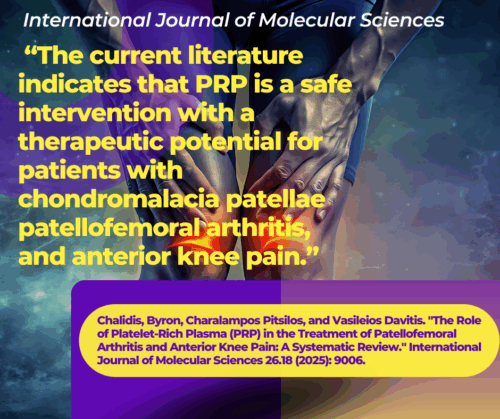
Another recent study documented the effectiveness of both Prolotherapy and PRP in the treatment of these knee conditions, stating: “The current literature indicates that Prolotherapy and PRP are safe interventions with therapeutic potential for patients with chondromalacia patellae, patellofemoral arthritis, and anterior knee pain.”(3)
Contact OrthoRegen for more information.
(1) Katz, Nicole B., et al. “Advanced Non-Operative Interventions for Anterior Knee Pain.” Current Reviews in Musculoskeletal Medicine 17.12 (2024): 589-615.
(2) Uslu, Emine Yıldırım. “Is Dextrose Prolotherapy More Effective Than Steroids in the Treatment of Distal Semimembranous Tendinopathy?” Cureus 16.10 (2024).
(3) Chalidis, Byron, Charalampos Pitsilos, and Vasileios Davitis. “The Role of Platelet-Rich Plasma (PRP) in the Treatment of Patellofemoral Arthritis and Anterior Knee Pain: A Systematic Review.” International Journal of Molecular Sciences 26.18 (2025): 9006.